Most people in India assume that small and medium entities means small or mid sized manufacturing units or retail stores. But in fact, not all the SMEs are traditional manufacturing or retail stores. They are many professional small and medium entities that are different from traditional SMEs. Let’s see the difference to rightly understand how professional SMEs are different from traditional ones.
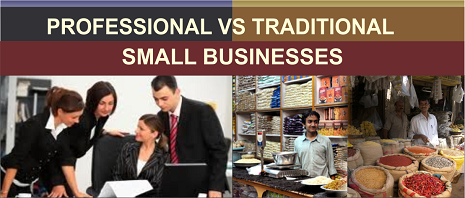
- People in the organization
- Professional SMEs: People working in these organizations are professionally qualified such as doctors, engineers, architects, lawyers, scientists, accountants, MBAs, etc.
- Traditional SMEs: People working in these organizations need not be professionally qualified. Therefore, no specific skills or qualifications are required to establish and execute a business.
- Goals
- Professional SMEs: Their main focus is to be economically viable. But not purely defined on profit maximization.
- Traditional SMEs: Their main focus on making a lot money. And they try to avoid many things such as taxes, employee welfare activities and facilities. Because they do not want to reduce what they made.
- How they operate
- Professional SMEs: They work in an organized way by adopting latest concepts and technologies to synchronize with the changing environment.
- Traditional SMEs: They work in organized way that was taught by their elders.
- Money Flow
- Professional SMEs: Most of the money flows through banking system.
- Traditional SMEs: Most of the money doesn’t flow through banking system.
- Distribution of power
- Professional SMEs: In these organization, power is decentralized based on knowledge or expertise.
- Traditional SMEs: In these organizations, power is centralized based on ownership and capital he/she invested.
- Hiring process
- Professional SMEs: Employees are chosen based on job description. And they hire mostly on merit basis rather than emotional concerns.
- Traditional SMEs: They hire employees who are known to them such as friends, relatives, family members who may or may not have skills required to do the job.
- How they treat employees
- Professional SMEs: They are employee oriented and they consider employees are the most valuable assets for their organization.
- They are more concerned to capital and connections than employees.
- Scope of career growth
- Professional SMEs: There are more chances of growth in their career as well as in their expertise.
- Traditional SMEs: Typically, in these organizations, no meaningful jobs roles exist. Therefore, no scope of career growth in their job.
- How they treat customers
- Professional SMEs: They are customer oriented. and always try to provide better service.
- Traditional SMEs: They are customer oriented but at times they neglect.
They are different in various disciplines. Professional SMEs provide decent employment opportunities to the freshers graduating every year in India. They support many big businesses which cannot perform any minute task from their end. Thus, there is a need to differentiate professional SMEs from traditional SMEs.